
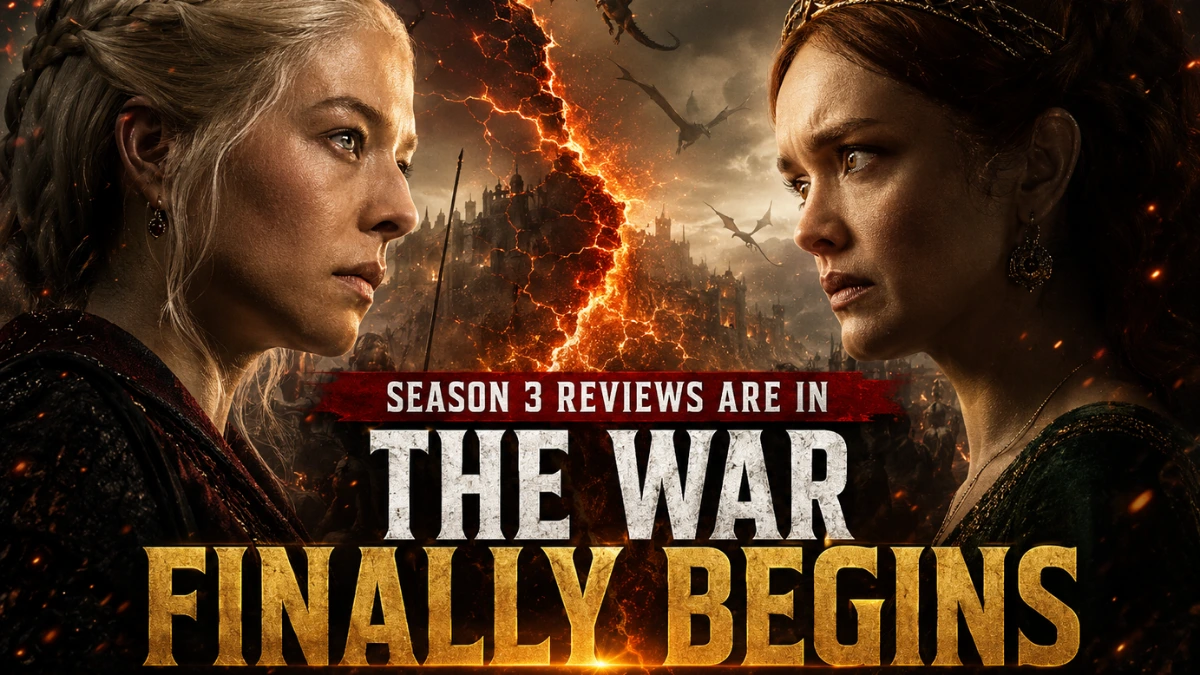
It took three seasons, but House of the Dragon may have finally reached the part of its story that viewers expected when HBO first announced a series about the Dance of the Dragons.
The early reviews are strongly positive, with critics praising the larger battles, heavier dragon action, sharper political drama, and a story that finally moves with real urgency. The season currently holds a 91% critics’ score on Rotten Tomatoes, while Metacritic lists a 75 score from 27 critic reviews.
That does not mean every reviewer is convinced. The Independent’s Nick Hilton argued that the show remains bombastic but shallow, while The Times’ Ben Dowell called it “old hat” and “boring.” Still, the overall response suggests that Season 3 is a substantial improvement over the second season.
The difference is easy to identify: the war is no longer being treated as something that might happen later. It has arrived.
The Story Finally Moves Forward
Season 2 was often criticized for spending too much time preparing for major events without delivering the battles and consequences viewers had been promised. Season 3 appears to correct that problem almost immediately.
In his review for RogerEbert.com, Kaiya Shunyata praised the season for picking up directly from the previous finale, with Rhaena searching for Sheepstealer, Daemon fighting in Rhaenyra’s name, Aemond occupying the Iron Throne, and Rhaenyra preparing to act on Alicent’s offer to surrender King’s Landing.
TheWrap’s William Goodman similarly argued that the series’ earlier setup finally begins to pay off. He described Season 3 as the point where the horrors of war reveal the true cost of the Targaryen family conflict.
That forward momentum is also what impressed Screen Rant’s Angel Shaw, who wrote that the season’s progress could help the series avoid the kind of disappointing ending associated with Game of Thrones.
The result is a season that feels less interested in positioning pieces and more interested in showing what happens when those pieces collide.
Dragons Are Finally Being Used Like Weapons
The dragon action is one of the clearest improvements highlighted by reviewers.
IGN’s Helen O’Hara gave the season a perfect score and focused on the sheer scale of its warfare, describing skies filled with dragons and seas filled with ships, all moving toward mutual destruction. Her review makes clear that the spectacle is no longer occasional decoration. It is now central to the season’s identity.
The Daily Beast’s Nick Schager also praised the season as an “assured and often-thrilling mixture of colossal battles and court intrigue.” That combination is important because House of the Dragon works best when its visual scale and political maneuvering strengthen each other.
The Guardian’s Jack Seale went even further, describing the opening stretch as the kind of epic the series should have been delivering all along. He specifically praised the balance between major battles and smaller scenes where characters fight for control through conversation, manipulation, and personal pressure.
For a show built around a civil war between dragon-riding Targaryens, the increased use of dragons feels less like fan service and more like the story finally accepting its own premise.
Rhaenyra Remains The Emotional Center
The spectacle may be getting the headlines, but Rhaenyra remains one of the season’s most important elements.
Emma D’Arcy’s performance continues to anchor the story as Rhaenyra is forced to confront the difference between wanting to rule and being capable of ruling during a war. Her decisions carry greater consequences, and the season appears increasingly interested in how power changes people who once believed they could control it.
TheWrap’s William Goodman praised the way the season gives the characters more room to confront the moral consequences of the conflict rather than simply moving them from one political meeting to another.
The emotional stakes also receive attention from The A.V. Club’s Jarrod Jones, who highlighted the Battle of the Gullet for combining family tensions and dragon warfare without losing sight of the people caught in the destruction.
That balance matters for Rhaenyra in particular. Her story is not only about winning the Iron Throne. It is about what she is willing to sacrifice to claim it, and whether the person who reaches the throne can still resemble the woman who once believed she deserved it.
The Political Drama Is Back
One of the strongest parts of Game of Thrones was always the tension before the violence: the schemes, the betrayals, the shifting alliances, and the conversations in which one badly chosen sentence could change the course of a war.
Season 3 appears to restore that balance.
Empire’s Caroline Siede described the season as more action-packed while remaining thoughtful, suggesting that the larger battles do not completely overwhelm the character drama.
The San Francisco Chronicle’s Bob Strauss praised the season’s faster pace and argued that plotlines established during the slower portions of Season 2 now pay off through sharper complications and twists.
Even reviewers who were less enthusiastic about the season acknowledged that the political material remains one of its strengths. The Independent’s Nick Hilton, despite criticizing the show’s shallow elements, noted that the new episodes contain plenty of visual spectacle and large-scale conflict.
The best version of House of the Dragon has never been a choice between political intrigue and dragon battles. It is a series where the political decisions make the battles inevitable, and the battles expose the consequences of those decisions.
Why Critics Are Calling It An Improvement
The strongest reviews are not claiming that Season 3 has solved every problem. Instead, they suggest that the series has become more confident about its pace, its scale, and its central conflict.
Collider’s Therese Lacson called the season “spectacle TV worth tuning in for,” while also warning that the back half could change the overall impression. Radio Times’ Louise Griffin praised the opening episodes but raised the question of whether such a strong start could lose momentum later.
That caution is worth keeping in mind. Most early reviews were based on only the first few episodes, not the entire season. A strong opening does not automatically guarantee a satisfying conclusion.
Still, the difference from Season 2 is clear in the language reviewers are using. The season is being described as more gripping, more devastating, more action-packed, and more confident. Rotten Tomatoes’ critics’ consensus calls it a “reinvigorated and riveting” chapter with stronger battles and new characters.
There are still questions about whether the season can maintain that momentum. But the early response suggests HBO has finally delivered the version of House of the Dragon that many viewers thought they were watching for in the first place: a brutal, politically charged Targaryen civil war where the consequences arrive instead of being endlessly postponed.