For years, the biggest fear surrounding Masters of the Universe wasn’t whether He-Man could defeat Skeletor. It was whether Hollywood would once again try to “fix” something that never needed fixing in the first place.
The 1980s franchise was always strange. It mixed fantasy, science fiction, giant cats, skull-shaped castles, laser weapons, muscle-bound heroes, and villains who looked like they escaped from a heavy metal album cover. Trying to make that world feel realistic was always going to be the wrong approach. Surprisingly, the new Masters of the Universe appears to understand that.
Early reviews have landed ahead of the film’s theatrical release, and while critics are divided on certain story decisions, one point keeps appearing across multiple reactions: Travis Knight’s adaptation succeeds when it embraces the franchise’s absurdity rather than apologizing for it.
A Movie Caught Between Nostalgia And Reinvention
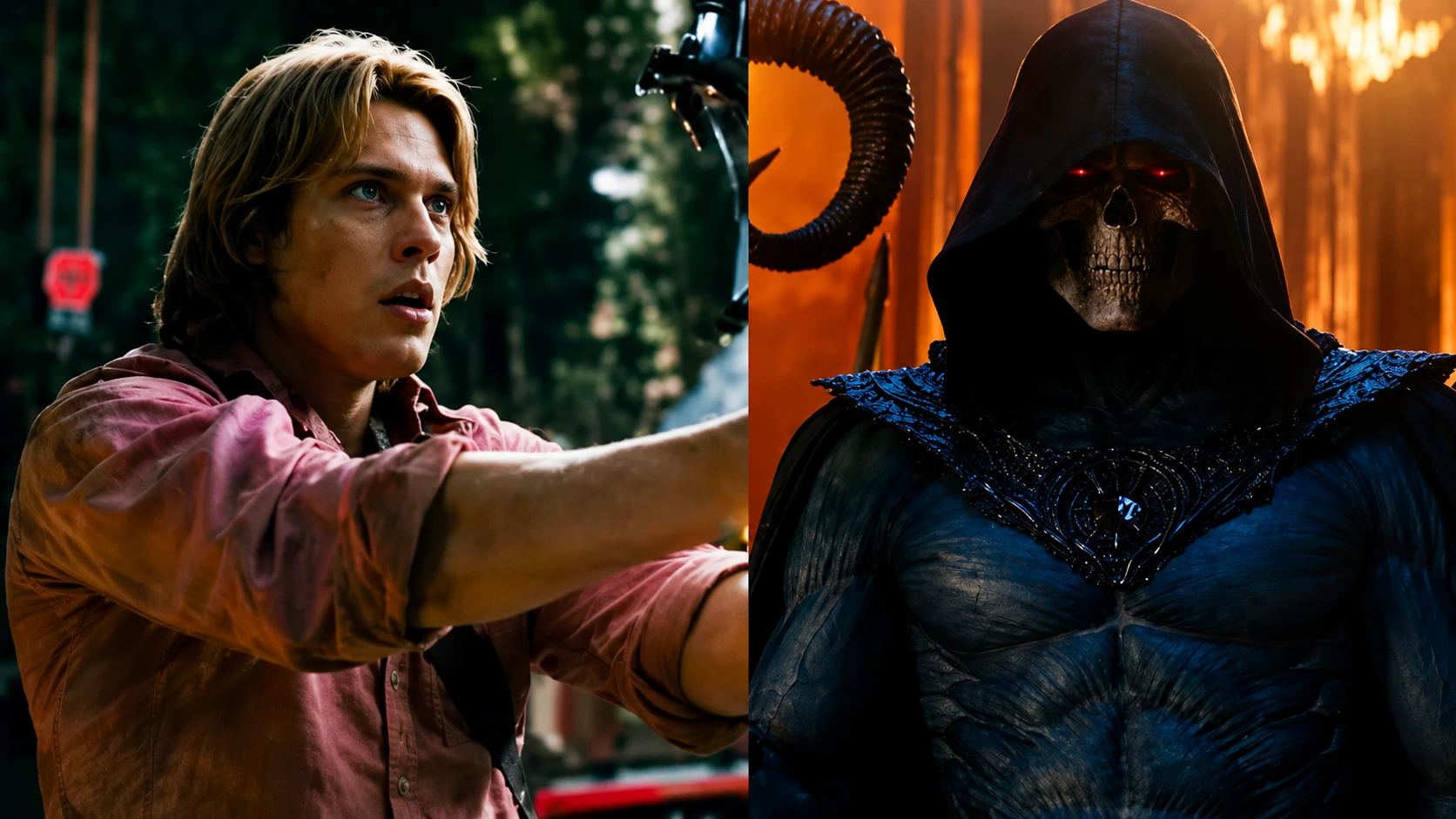
The film follows Prince Adam, played by Nicholas Galitzine, who has spent years living on Earth before discovering his connection to Eternia and his destiny as He-Man. From there, the story launches into a large-scale fantasy adventure involving Skeletor, Castle Grayskull, ancient powers, and the battle for Eternia itself. That setup sounds familiar, but the execution has sparked interesting reactions.
The reception isn’t universally positive. Some critics have praised the movie for feeling like a colorful Saturday morning cartoon brought to life, others argue that the film occasionally struggles to balance its modern themes with the larger-than-life spirit that made the original franchise popular. Some critics argue the film runs longer than necessary and occasionally struggles with pacing, while thers feel the tone shifts between comedy, nostalgia, and epic fantasy can become uneven.
Nicholas Galitzine Emerges As The Film’s Biggest Strength
One area where critics seem surprisingly united is Nicholas Galitzine’s performance. Physical transformation alone was never going to be enough. Fans expected the muscles. They expected the iconic look. What mattered was whether Galitzine could make Adam feel like more than a walking action figure, which according to multiple critics, he largely succeeds.
Rather than portraying He-Man as an unstoppable macho warrior from the start, Galitzine reportedly gives Adam vulnerability, uncertainty, and even awkwardness. That approach allows the eventual transformation into He-Man to feel earned rather than automatic. It’s an interesting shift because the character becomes less about raw strength and more about discovering confidence.
Jared Leto’s Skeletor Might Be The Most Divisive Element
If Galitzine is earning praise, Skeletor seems to be generating the widest range of reactions. Some critics describe Jared Leto’s performance as wildly entertaining and memorable. Others feel the character occasionally pushes the film too far into camp. The truth is that Skeletor has always been a difficult character to adapt. He’s part fantasy warlord, part comic-book supervillain, and part theatrical maniac. Any live-action version was going to divide audiences.
From the reviews, it sounds like Leto fully commits to the role, which may either become one of the movie’s biggest selling points or its most controversial creative choice depending on the viewer.
The Visual World Finally Feels Like Eternia
One complaint frequently directed at older adaptations was the tendency to pull He-Man away from Eternia and place him in more grounded environments. This version appears much more committed to the franchise’s fantasy identity.
Reviewers repeatedly mention giant-scale world-building, colorful creatures, elaborate costumes, and the bizarre blend of fantasy and science fiction that defined the original property. That decision may end up being the film’s smartest move.
Instead of treating Eternia like an embarrassing relic from the 1980s, the movie reportedly leans into the weirdness with confidence. And in an era where many franchise films often look visually interchangeable, that uniqueness matters.
Rather than chasing realism, the movie appears determined to embrace giant swords, magical kingdoms, oversized villains, and pure fantasy spectacle. Many critics love that decision and m aren’t fully convinced. But almost everyone seems to agree on one thing: this isn’t a movie embarrassed to be a He-Man movie.
And after decades of reboots trying to reinvent beloved properties into something else entirely, that may be the most powerful thing Masters of the Universe has going for it.

Sujal Singh and Nikev Maze are the founders and editors of Cinemazze, where they lead the platform’s editorial vision and content strategy. With a deep interest in the entertainment industry, they focus on delivering timely coverage of movies, television series, streaming releases, celebrity news, trailers, and major industry developments. Their editorial approach combines accurate reporting with audience-focused storytelling, helping readers stay informed about the latest trends shaping modern entertainment. Through Cinemazze, they aim to build a trusted destination for entertainment enthusiasts by publishing well-researched articles, insightful analysis, and up-to-date news sourced from official announcements, verified interviews, studio releases, and other credible public sources. Their commitment to quality, transparency, and reader value remains at the core of Cinemazze’s mission as it continues to grow within the digital entertainment media landscape.