
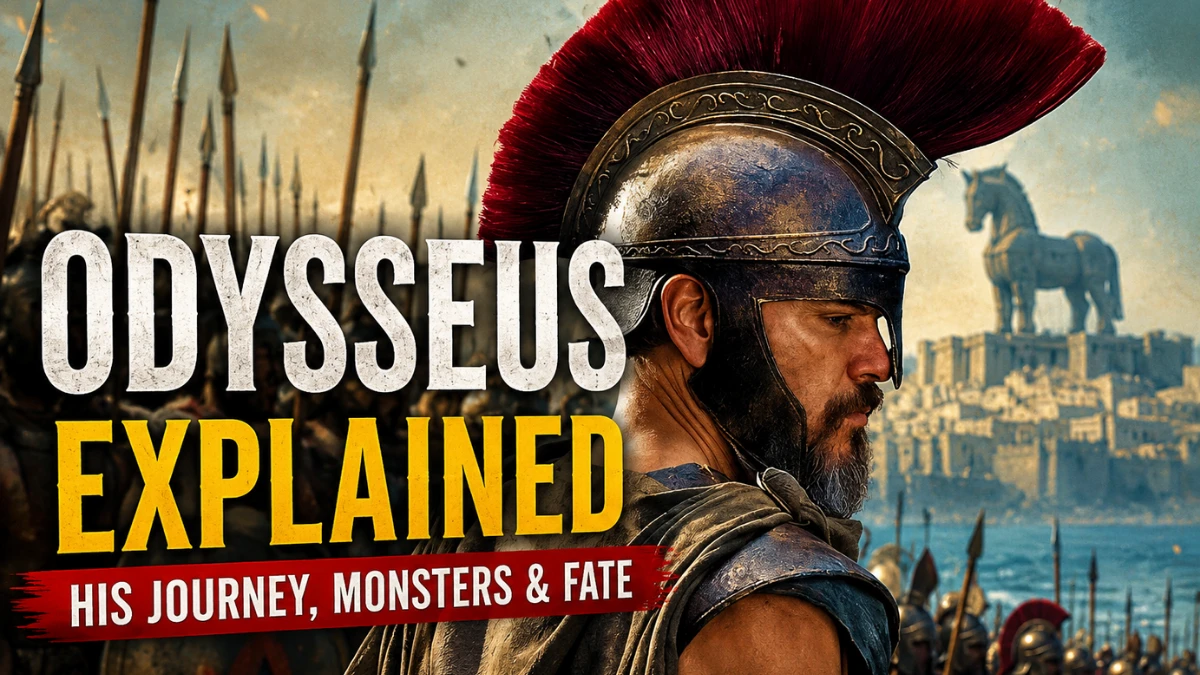
Few figures in mythology are as influential as Odysseus. Best known as the clever King of Ithaca, Odysseus became one of ancient Greece’s greatest heroes through his intelligence, courage, and determination. While warriors like Achilles relied on strength, Odysseus won battles through strategy, leaving behind a legacy that still shapes storytelling thousands of years later.
The King Of Ithaca Who Changed History
Odysseus was the son of King Laertes and Anticlea, and brother to Ctimene. He married Queen Penelope of Sparta, and together they had a son, Telemachus. When the Trojan War began, Odysseus initially tried to avoid leaving his family by pretending to be insane, but his deception was discovered, forcing him to join the Greek army.
His greatest achievement during the war was creating the legendary Trojan Horse, the strategy that finally allowed the Greeks to capture the seemingly unbeatable city of Troy. Rather than overpowering his enemies through force, Odysseus proved that intelligence could be just as powerful as any weapon.
A Journey Filled With Monsters And Gods
After the Trojan War ended, Odysseus faced an even greater challenge—returning home. His voyage lasted another ten years, turning his life into the story told in Homer’s Odyssey.
During his travels, he blinded the terrifying Cyclops Polyphemus, escaped the deadly songs of the Sirens by tying himself to his ship’s mast, survived the monstrous Scylla and the giant whirlpool Charybdis, and rescued his crew from the forgetful Lotus-Eaters. He also spent years with the enchantress Circe and the nymph Calypso, both of whom delayed his journey back to Ithaca.
Throughout these adventures, Odysseus repeatedly relied on quick thinking rather than brute force, making him mythology’s greatest trickster hero.
Penelope’s Loyalty And Odysseus’ Family
While Odysseus struggled to return home, Penelope remained fiercely loyal despite being surrounded by suitors who believed her husband was dead. She cleverly delayed choosing a new husband by weaving a funeral shroud during the day and secretly unraveling it each night.
After finally returning to Ithaca, Odysseus reunited with Penelope and his now-grown son Telemachus, who helped him defeat the suitors occupying their home.
Later myths expanded his family even further, giving him children with Circe, including Telegonus, whose role would become central to Odysseus’ tragic fate.
The Tragic Ending Of Odysseus
Unlike Homer’s Odyssey, later myths describe a heartbreaking ending for the legendary king.
According to The Telegony, Telegonus unknowingly traveled to Ithaca searching for his father. During a conflict over stolen cattle, he accidentally killed Odysseus with a spear tipped with stingray venom, fulfilling a prophecy that the hero would die by something that came “from the sea.”
The story ends with an unusual twist. Telegonus took Penelope and Telemachus to Circe’s island, where immortality was granted, and later traditions claim Telegonus married Penelope, while Telemachus married Circe.
Why Odysseus Still Matters Today
Odysseus remains one of the most important characters in world literature. The Iliad and The Odyssey laid the foundation for Western storytelling, inspiring countless novels, films, and television series. His adventures also helped define the famous Hero’s Journey, a narrative structure still used across modern entertainment.
More importantly, Odysseus proved that the greatest heroes aren’t always the strongest—they’re often the smartest.